Search is splitting in two. Your future clients still Google — but a fast-growing share now ask an AI assistant first, and the firm the AI names by name is the one that gets the call. This is a shift, not a collapse: Google is still the biggest surface by far. But the ground under law-firm marketing is moving, and the firms that plan for it now will own the answer in their niche before their competitors notice the question. Here is what the 2026 data actually shows — with the honest caveats attached, because a number you can disprove is worth less than no number at all.
Where do people actually get AI answers now?
Across six surfaces, and the audience is measured in billions. Google’s AI Overviews reach about 2.5 billion people a month (Sundar Pichai, Google I/O, May 2026); ChatGPT sits near 1.1 billion monthly (third-party estimate, Sensor Tower) and passed 1 billion weekly active users in 2026 (OpenAI); the Gemini app crossed 1 billion monthly (Google, August 2026); Google’s AI Mode reached 1 billion monthly; Perplexity is around 230 million and Anthropic’s Claude around 33 million (mixed and third-party estimates).
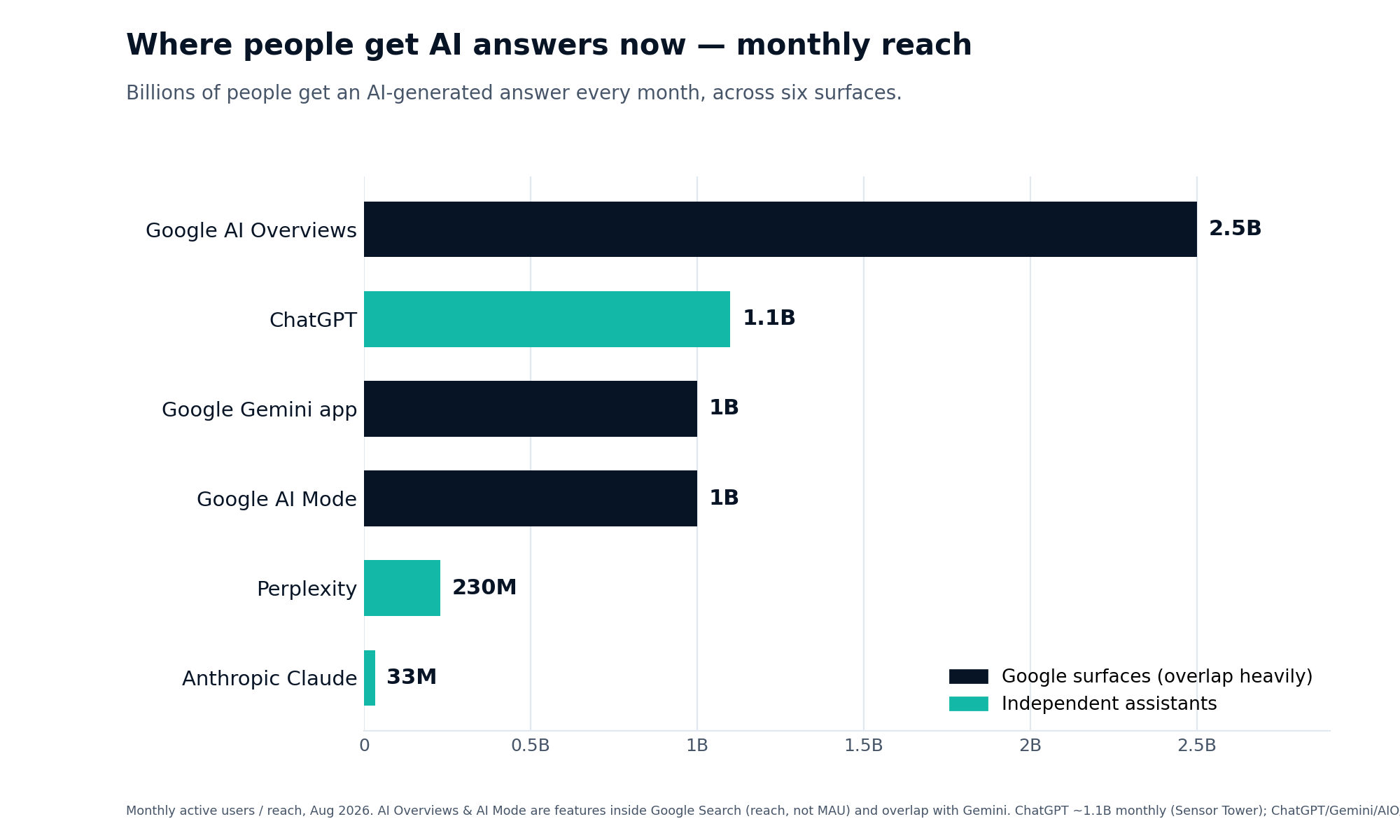
The honest reading of that chart is not “everyone left Google.” The surfaces overlap — many people use several — and “users” are not “your prospective clients.” But the scale is the point: the place where someone asks “who’s the best immigration lawyer near me” is no longer a single search box. It is half a dozen answer engines, most of which reply with a short list of named firms.
How fast did this actually happen?
In about two years — the fastest consumer-technology adoption on record. ChatGPT went from roughly 200 million weekly users in August 2024 to more than 1 billion by mid-2026. The Gemini app went from launch to 1 billion monthly users in roughly 27 months. For comparison, technologies we think of as fast — smartphones, social media — took the better part of a decade to reach comparable scale.
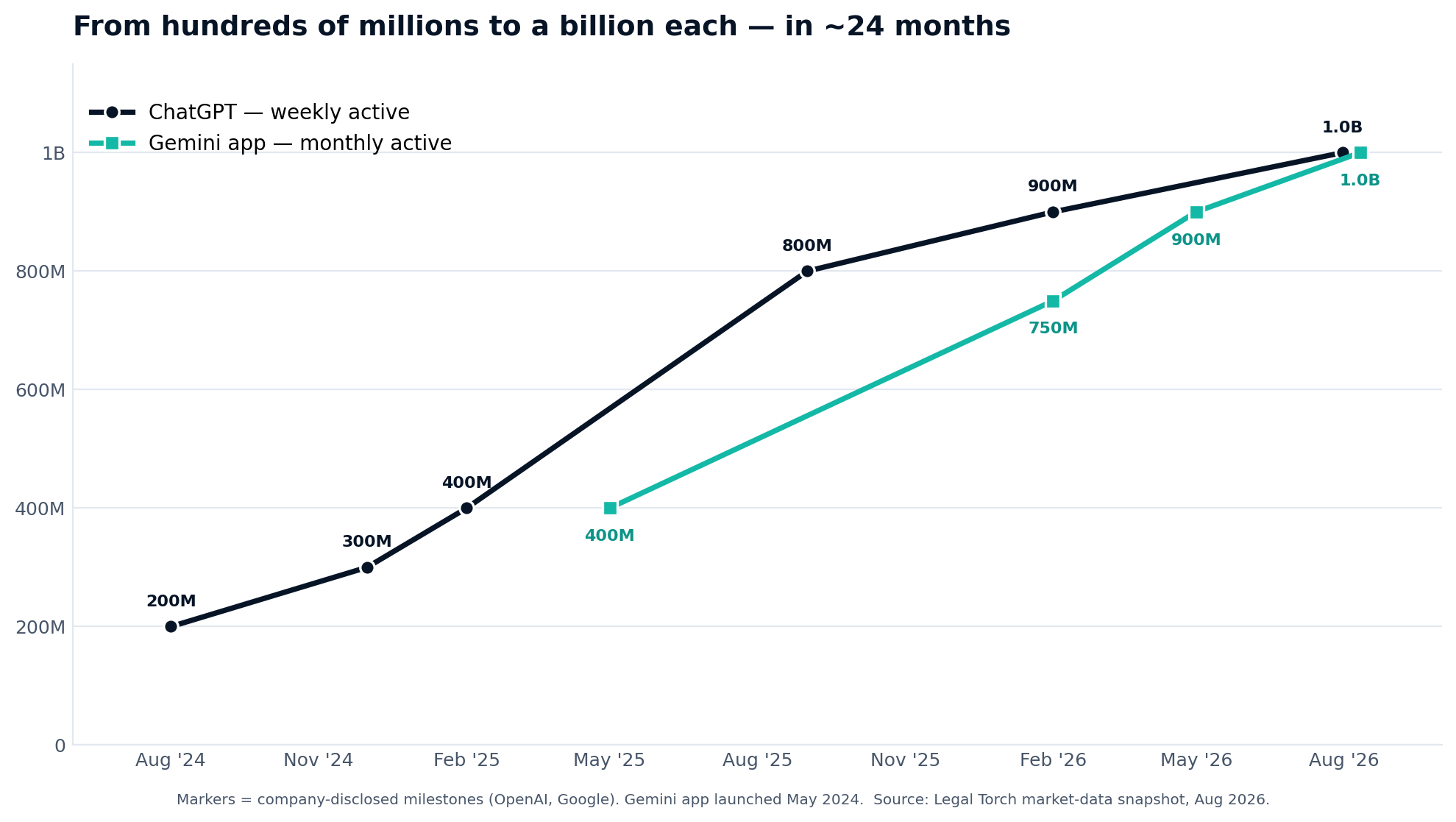
Why does the speed matter to a law firm? Because marketing advantages compound. A decade of search-engine optimization is why the biggest firms dominate Google today. On the AI surfaces, no one has a decade of anything yet. The firm that becomes the recognized answer for “estate planning attorney in Pasadena” this year is the name these systems keep repeating next year.
Is Google finished, then?
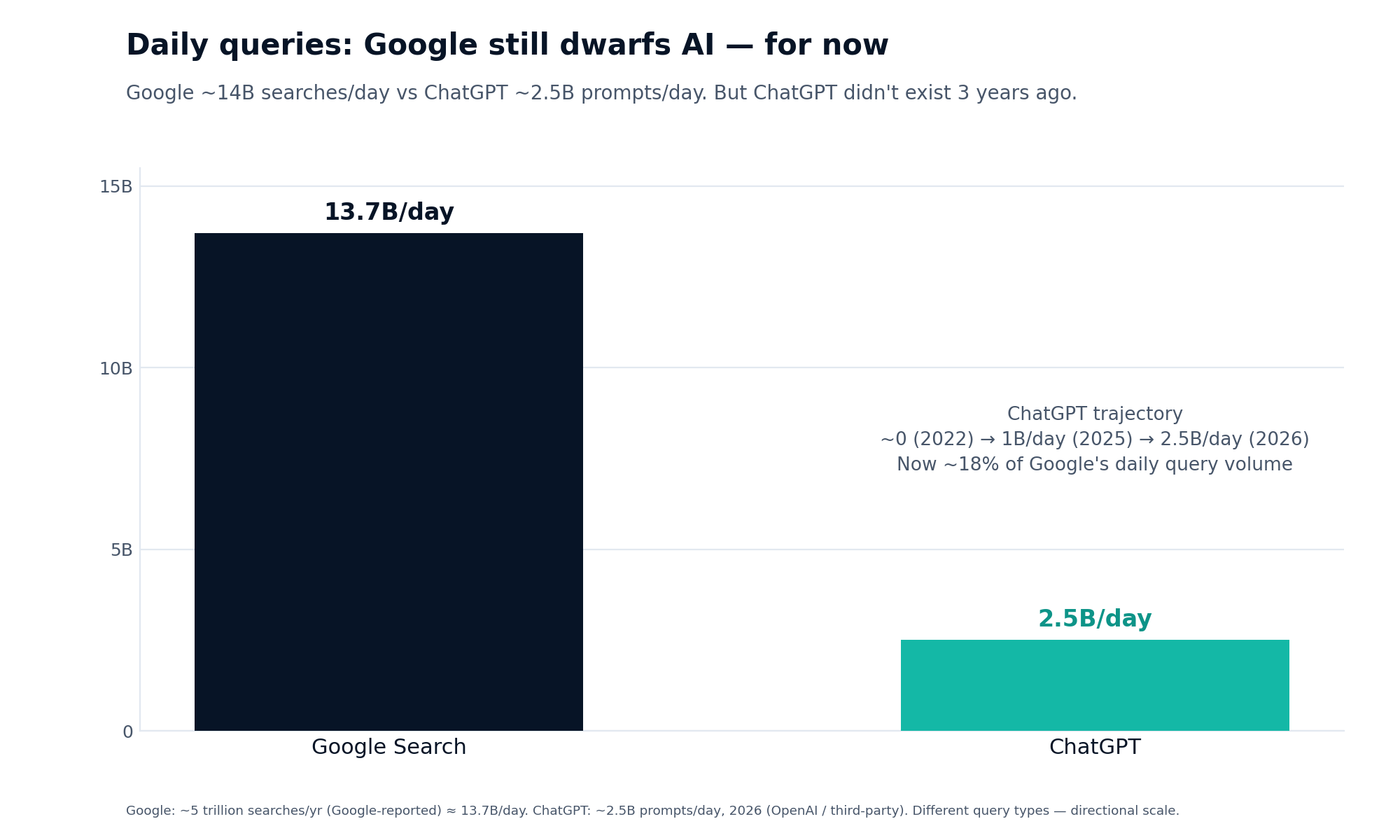
No — and any marketer who tells you otherwise is selling fear. Google still processes on the order of 14 billion searches a day (roughly 5 trillion a year, Google-reported), against something like 2.5 billion prompts a day for ChatGPT. In raw volume it isn’t close. This is why we call it a shift and not a collapse: the smartest move is not to abandon Google, it is to keep what works there and claim the new surface while it is still contestable.
So why does this change anything for my firm?
Because the click — the thing your website has always depended on — is disappearing into the answer. When an engine answers on the page, most people never click through to anyone. The share of U.S. searches that send a click to any website has fallen from about 42% in 2024 to roughly 32% in 2026 (Similarweb / SparkToro clickstream data), and it drops further wherever an AI answer sits on the page.
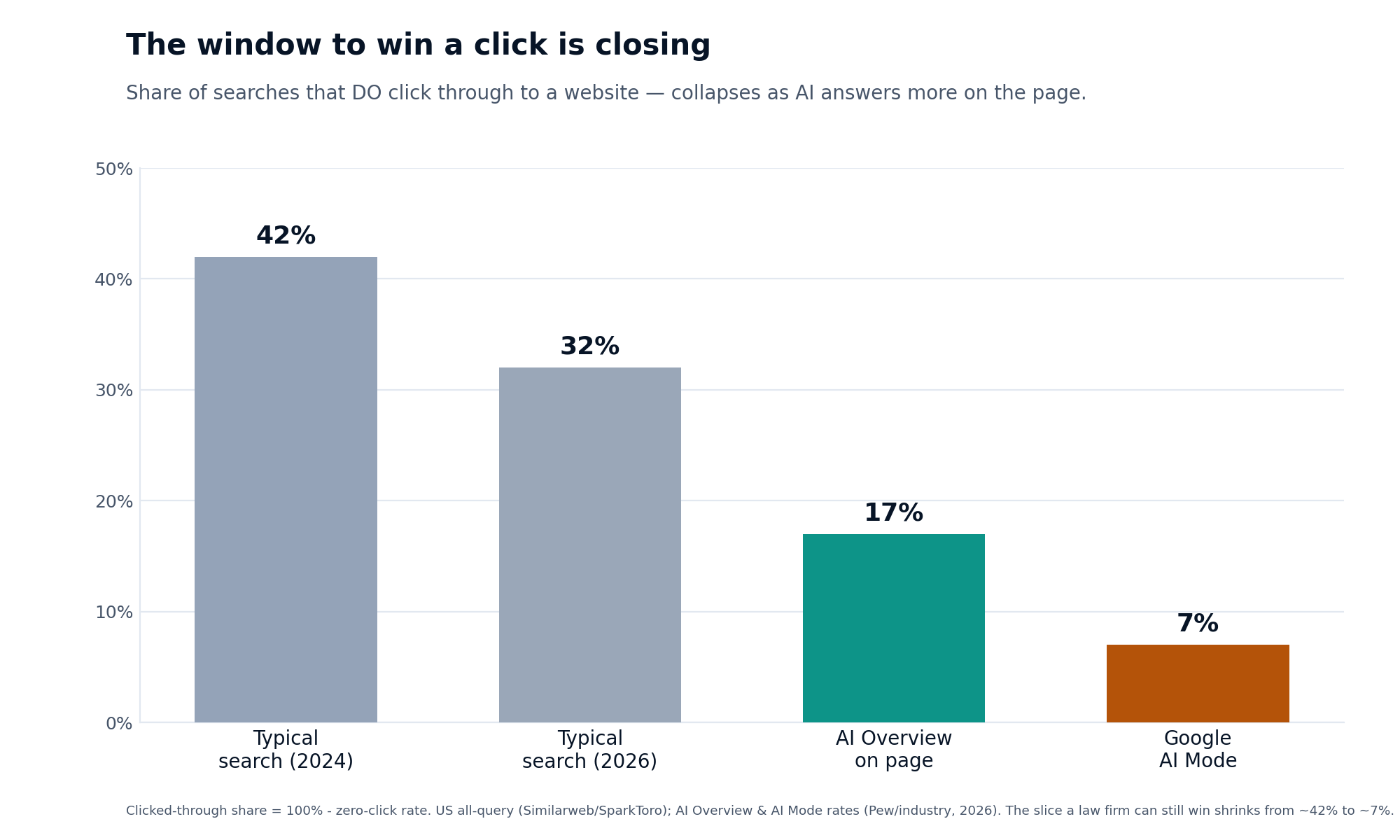
Read that trend against how law firms buy visibility today and the problem is clear. Pure SEO wins a ranking that fewer and fewer people click. Pure pay-per-click buys a spot on a page where the AI answer increasingly sits above it. Neither is dead — but both get tighter every quarter the answer engines expand. The exception is the firm that is named inside the answer itself. That firm gets the exposure whether or not anyone clicks a link.
Doesn’t that just mean I should spend more on Google Ads?
You can — but the data says being cited in the AI answer is what makes those ad dollars work harder. On research-heavy queries, brands cited in the AI Overview averaged a 15.7% paid click-through rate, versus 11.2% for brands not cited on the same results page — roughly 40% higher (Seer Interactive analysis of 5.47 million queries, 2026; directional and query-set dependent). Being the named answer helps twice: it wins the organic exposure that’s vanishing for everyone else, and it lifts the paid clicks you’re still paying for.
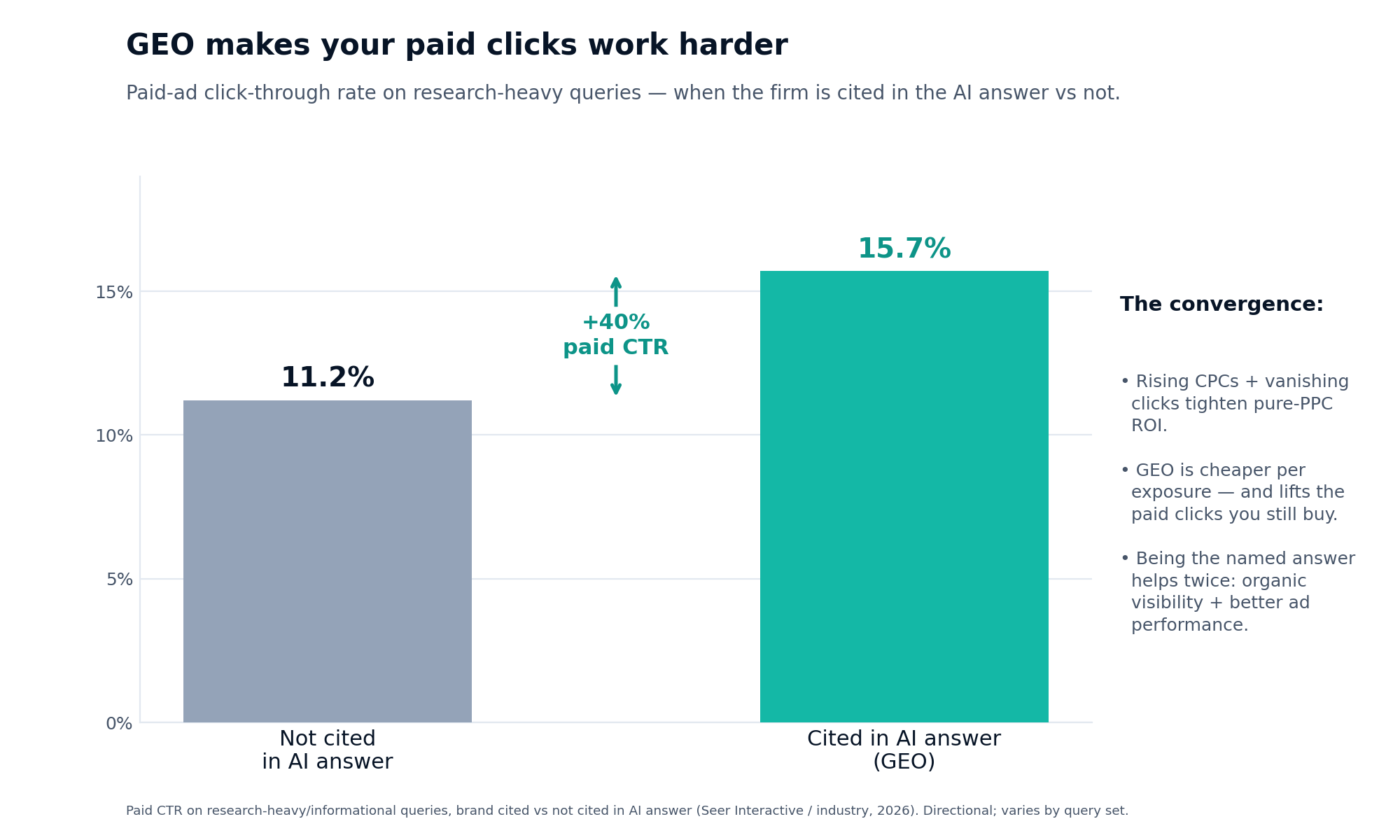
This is the convergence worth sitting with. Rising ad costs and vanishing free clicks squeeze pure-PPC economics from both sides. Generative engine optimization — the work of becoming the cited answer — is cheaper per exposure than buying every click, and it lifts the clicks you still buy. The two stop being separate line items and start reinforcing each other.
What should a law firm actually do about it?
Two things, in order. First, measure where you stand. You cannot manage a surface you can’t see, and AI answers vary by engine, by day, and by how the question is phrased — so a single screenshot proves nothing. The honest way to measure is a panel: the six engines above, each question asked several times, depersonalized, with the raw evidence saved. That tells you whether the engines name your firm for the questions your clients are actually asking.
Second, become the answer for the questions that precede hiring you — the practice-area, community, and place-specific questions where a well-defined firm can out-earn a bigger, broader competitor. That is entity and citation work, structured content that answers real client questions directly, and placement in the sources these engines trust. On broad head terms, deep-rooted incumbents still win; in a specific niche, no one’s roots run deep yet, and first movers claim the name.
For the full picture of the numbers behind this shift, see the state of AI search for law firms: the 2026 data, and for what the work involves and what it costs, the complete GEO guide for law firms.
One thing we will not do is promise you rankings, leads, or a signed client. No honest agency can — AI answers move, and California’s Rule of Professional Conduct 7.1 rightly forbids guarantees about outcomes. What we measure and work to improve is your visibility: whether the engines name your firm when it counts. The free AI Visibility Audit tells you where you stand across the six engines before you commit to anything — and you keep the analysis either way.
Common questions about the shift to AI search
Short answers to the questions law-firm owners ask most about this transition.
Will AI replace Google for finding a lawyer?
Not replace — but it is reshaping how people search. Google still handles far more volume than every AI assistant combined (about 14 billion searches a day), so it isn’t going away. What’s changing is that a fast-growing share of clients now ask an AI assistant first, and when they do, the engine answers with a short list of named firms instead of ten blue links. The practical takeaway is not “abandon Google,” it’s “keep what works there and make sure the AI answer names you too.”
What is GEO (generative engine optimization) for law firms?
GEO is the work of getting your firm named and cited when an AI assistant answers a prospective client’s question — on ChatGPT, Google AI Overviews and AI Mode, Gemini, Perplexity, and Claude. It combines entity and schema work, structured content that answers real client questions directly, and placement in the sources these engines trust. Think of it as optimizing to be the answer, rather than optimizing to be a link the searcher then has to click.
Is SEO still worth it for law firms if AI is taking over search?
Yes — the two are additive, not either/or. A strong Google ranking still helps, and it modestly improves your odds of being cited in an AI answer. But ranking no longer decides citation the way it once did, and a growing share of searches never send a click at all. The firms in the best position pair traditional SEO with GEO, so they hold their Google visibility and show up inside the AI answers where more research is now happening.
How do you measure whether AI search names my firm?
With a panel, not a screenshot. AI answers vary by engine, by day, and by phrasing, so a single result proves little. The honest method is to test the same client questions across the six major engines, ask each several times, strip out personalization, and save the raw evidence — then report per engine, with no single made-up “score.” That shows whether the engines actually name your firm for the questions your clients ask. To be clear about what this measures: it tracks visibility, not guaranteed rankings, leads, or signed clients — no honest agency can promise those.
Can a small firm compete in AI search against bigger firms?
Often better than on Google, because the field is wide open. Most firms are still invisible on AI surfaces, and these engines reward the clear specialist answer for a specific practice area, community, and place — not the biggest ad budget. On broad, competitive terms the deep-rooted incumbents still win. But in a well-defined niche, no one’s roots run deep yet, and the firm that becomes the recognized answer first tends to keep being named.